Story: ,

Mayor's Office meeting register: January - March 2014

Office sign photo

Since Mayor Naheed Nenshi was first elected, he has published monthly lists of meetings he's taken in his office. This was a voluntary action in the absence of a formal policy. In July 2013, at his urging, Council agreed to publish quarterly lists of meetings held with members of the public (IE: not City of Calgary employees) in the offices of the mayor and councillors. This is the list of meetings for the first quarter of 2014.

Click here to view a list of meetings with Mayor Nenshi.

Click here to view a list of meetings with Mayor Nenshi's staff.

The details of the new disclosure policy can be found in the Ethical Conduct Policy for Members of Council. Here is the specific quote related to disclosing meetings:
All visitors shall be encouraged to sign a form with appropriate language allowing release of their names as per Freedom of Information and Protection of Privacy legislation. Members of Council and their staff shall disclose a list of those external visitors to The City (excluding Media), with whom they have met in their offices quarterly.
- Posted by Daorcey from Mayor Nenshi's team

Story:

Mayor Nenshi on multiculturalism and diversity


In June 2014, New Canadian Media met with Mayor Nenshi do discuss diversity in our community and his personal story of growing up in Calgary. Here is the full test of the resulting article: 


Naheed Nenshi’s meteoric rise – from relative obscurity to being the new face of Western Canada – was fodder for international media when he first became Calgary’s mayor in 2010. Since then, he has orchestrated the city out of last year’s devastating flood, winning him accolades, trending hashtags, and a second term in office.

Yet four years ago, political pundits wondered: how could Canada’s arguably most conservative city elect a non-white Muslim mayor?

Nenshi – a former Harvard-educated academic – says Calgarians didn’t care much about his background or his skin colour. In fact, they bristled at anyone who did.

“The issue of my faith came up exactly twice [in Calgary], and both times there was a huge backlash against people even talking about it,” says Nenshi, his first term evidenced from the multiplying grey hairs in his messy mop of trademark curls.

“People would phone the newsrooms and say, ‘Why do I care? I want to know what he wants to do about transit. It was only after I was elected – immediately after I was elected, within hours – that I suddenly found myself being very famous. And people from outside of Calgary wanted to know about this Muslim mayor.”

Nenshi says he was reluctant to discuss his heritage at first, deeming it irrelevant to his work as the city’s mayor. Today, he admits it’s “an incredibly important part of my identity and the way I see the world.”

Personal story

His story is not unlike that of countless other Canadians, who left their home countries in search of brighter prospects. For the Nenshi family, it meant leaving their native Tanzania in the early 1970s while the mayor’s mother was still pregnant with him.

He says he grew up wondering why his family had “big fancy citizenship certificates” and all he had was a “lousy birth certificate,” realizing later in life those pieces of paper were deeply meaningful. It was a sentiment that snowballed and soon morphed into a profound sense of appreciation for what makes Canada a beacon for immigrants.

“As minority communities, we often focus on things that could be better, such as the discrimination or lack of equal opportunity,” says Nenshi.

“We need to focus on the extraordinary place in which we live,” insisting that every child, regardless of where they come from or what they look like, has the opportunity to realize their Great Canadian dream.

“I believe I’m one of five non-white city council members ever, in history,” acknowledging his own Great Canadian dream realized.

Nenshi wants to see other newcomers looking to fulfill their own ambitions – not just for their children. In order for that to happen, he says, more groundwork needs to be done, be it through offering incentives to quit their jobs and return to school, improve their English skills or acquire accreditation in the professions for which they’ve already been trained.

“People have to be able to understand that it’s possible here and it isn’t possible everywhere,” says Nenshi. “For many of us, it isn’t possible in the countries we came from.”

Success stories

He rattles off some success stories with a deftness that hints he’d told them many times before: a man who immigrated from Colombia after being mayor in his own hometown, and found work in Calgary as a house painter, only to quit his job, enroll in college and take on an internship in city hall, which would soon lead to work in Mayor Nenshi’s office.

Nenshi then recalls meeting a woman from India who worked as an assistant manager at McDonald’s, who was able to put her son and daughter through college, yet still continued working at the restaurant for 27 years simply because she liked working there and wanted to ensure other newcomers who came after her could have the same experience.

The stories – albeit uplifting – may perhaps be a way to offset the negative publicity some of the country’s immigration programs have garnered. Chiefly, the Temporary Foreign Worker program which continues to get mired in controversy. The TFW program was designed to be a two-way street: an avenue for foreigners seeking work and a pathway to eventual Canadian citizenship, all while filling a void in the country’s labour market. Today, Nenshi says, the public perception of the program has changed.

“Now what you have is people saying Temporary Foreign Workers are not well treated, that we’ve created a second class of Canadians – people who don’t have the right to stay here,” says Nenshi.

“Those are very deep moral issues that we have to talk about.”

He says the success of Canada’s immigration system hinges on three levels: policy, programs and people.

“The [federal] government has to get the policy right – how many people do we let in? What kinds of people do we let in?” he says, adding the other two facets are even more important than getting policy right.

Settling in

Newcomers can’t walk that road alone. Nenshi says non-profit agencies, government, and immigrant-serving agencies all have a role to play in offering programs to assist immigrants settle in, from accessing language training to getting a foreign degree accredited.

Nenshi admits he may not be politically correct, but integration entails “fluency in English, reducing accents, [and] being able to get more in the workplace.” He says confronting that issue can mean wiping out other social problems that arise from it, such as generational poverty.

Yet, at the heart of it all, people can make all the difference in assisting newcomers and prove to be the most vital element.

“It really is about those human linkages and human beings helping one another think about better ideas,” he adds.

He says he’s “very optimistic” the community will tap into its full potential and continue to welcome immigrants, in spite of “little strains of xenophobia that have crept into the conversation.”

Case in point: Quebec’s controversial Charter of Values, a bill that was famously proposed by the former Premier Pauline Marois in 2013, which restricted government employees from wearing religious symbols, such as turbans and hijabs.

“The fact that the ‘Charter of Racism’ (as I call it) was voted down soundly in Quebec says a lot about who we are as a community,” says Nenshi. “It’s because people fought against it and stood up and said, ‘That’s not right. That’s not the Quebec we live in, that’s not the Canada we live in, that’s not the world we want for our kids.’”

“We have to keep doing it every single day or we risk sliding backwards,” he adds.

Nenshi says he’s heartened by the strides made in Calgary, suggesting the city may truly be colour blind – or at least partially.

“Those of us who are minorities learn to live with it and we learn to overcome it,” he says, citing his own Member of Legislative Assembly, Manmeet Bhullar. “[Bhullar] is a large man with a beard and a turban, and nonetheless is the Minister of Human Services.”

“I think that speaks incredibly well of our ability to move forward.”
Story:

Reflections on student life at the Haskayne School of Business

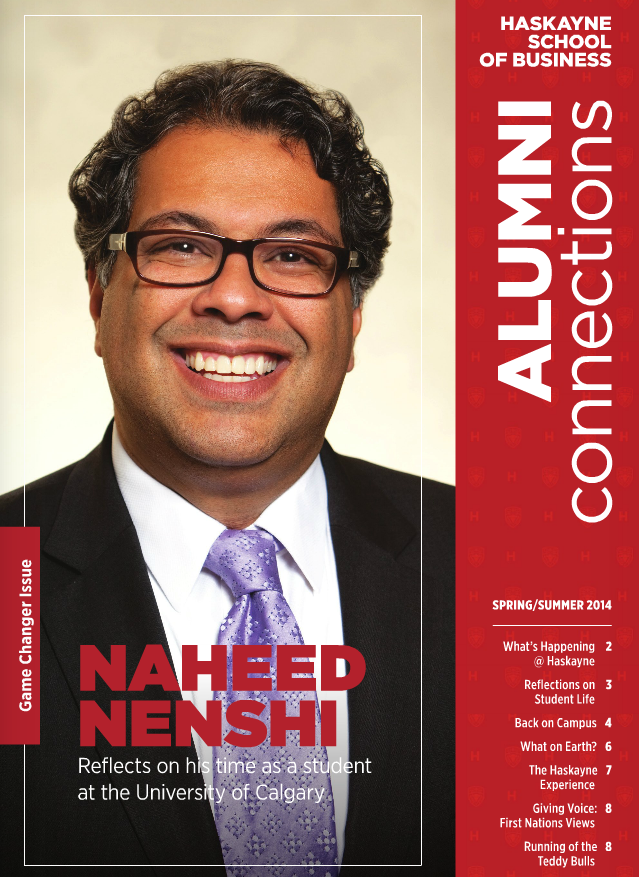
In the spring of 2014, Mayor Nenshi chatted with Alumni Connections for the Haskayne School of Business at the University of Calgary, his alma mater. You can view that article on page 3 using this link. The full text is below:

Reflection on student life: It’s all about getting involved

When Mayor Naheed Nenshi (BComm’93) thinks back to his time at Haskayne, he thinks of connectedness.

Not surprising from an alumnus who did everything from joining the ICBC team four years running, to serving as President of the U of C Students’ Union, to editing the Scurfield Squire (with his current Chief of Staff, Chima Nkemdirim (BComm ’94), who also served as Vice President External on the SU), down to simply taking the time to catch up with people in Scurfield Hall. All this involvement grounded the Mayor, and lay the foundation for the high level of involvement and disclosure he brings to everything he does. He has also maintained some key university connections.

Before becoming mayor of Calgary, Mr. Nenshi worked in the private, public and non-profit sectors including a stint at McKinsie & Company and starting his own consulting firm. He enjoyed spanning the three worlds, as they each had specialized processes. His consultancy was equally effective for retail as it was for the arts, proving that he had armed himself with the right tools and an attitude for success.

“It’s about more than transparency,” he explains, “it’s inviting people into decision making, and giving them the full information to make decisions.”

As for his love of Calgary and his alma mater’s role within it, Mayor Nenshi has some great advice. The university has done a good job of attracting talent, but he feels it is poised to do even more with undergrads. Calgary can keep the talent here with all it offers in quality of life—it has the arts, nature, and is an entrepreneurial, dynamic home for families to grow. It is no accident that so many head offices are in Calgary, especially when telecommuting is possible the world over. It’s simply a great place to be.

However, as alumni, we could do more. Mayor Nenshi asks his fellow graduates to advocate with our governments for accessible post-secondary education. “Post-secondary education is not an ivory tower, it’s the ticket to a great life for everyone.”

The Mayor encourages all University alumni to use the skills acquired to take up his “3 Things for Calgary” challenge. Bring your creativity and knowledge into what you pay forward. Everyone has the power to change their community, in their own way, within their abilities. Haskayne alumni have a special opportunity to use their management skills to make many improvements in the community.
Take up the Mayor’s challenge: “If everyone did at least 3 Things for Calgary, we’d have more than 3 million actions that would make this an even better city.” Join the board of a non-profit, help audit the books, use your management skills to improve public services. Do so with U of C pride! 

Mayor Nenshi, Sharon, and Bram sing Skinnamarink


One of the neat things about being mayor? You get called up to sing Skinnamarink with renowned children's performers Sharon and Bram (of Sharon, Lois, and Bram). Mayor Nenshi joined the duo on stage at the 2014 Calgary International Children's Festival.
Story: ,

Remember the flood and celebrate the spirit of Calgary on Saturday, June 21

Mayor Nenshi at a community cafe during the 2013 floods
On June 20 and 21 last year, Calgary faced the greatest challenge in its history. This year, let's remember the flood while celebrating the spirit of Calgary and the remarkable outpouring of kindness, help, and citizenship exhibited by all Calgarians.

The best way to celebrate community is to do it in the community. On Saturday June 21, 2014, join with your neighbours in every community in Calgary to get to know each other better. Some communities are having block parties, some are having barbecues on their front lawns (instead of their back decks), some are coming together to clean up their neighbourhoods after this long winter.

Check with your local community association on what's planned in your neighbourhood, or, even better, organize something yourself. Enjoy the longest day of the year and kick off the summer by getting to know your neighbours better.

The City of Calgary has prepared a website for what we're calling Neighbour Day at calgary.ca/neighbourday. You'll find ideas on what you can do, as well as simple tools to help you organize that block party or community clean-up. And make sure you let your City Councillor and the Mayor know what you're up to—you may find yourself with an unexpected guest!

“We've had a tough year,” said Mayor Naheed Nenshi. “But it's also been a year of triumph as we showed the world who we are and how we help each other. On June 21, let's remember what we've lost, but celebrate what we've gained: an even stronger community. Get to know your neighbours--it's the most rewarding thing you can do!”

For more information, ideas on how to celebrate, and tools and templates to help plan your Neighbour Day event, visit calgary.ca/neighbourday.

Neighbour Day is part of The City of Calgary’s one-year commemoration of the 2013 June Flood. A formal commemoration event will be taking place on June 20. Details of that event will be released in the coming weeks.

For more information on flood recovery and flood preparation, visit calgary.ca/floodinfo.

(Cross-posted from The City of Calgary Newsroom)
Story:

Wear red for the National Day of Honour: May 9, 2014


May 9, 2014, has officially been declared by the federal government as National Day of Honour to commemorate the end of the Afghanistan mission. This day is a way for Canadians across the country to acknowledge the strength and the sacrifices made by members of the Canadian Armed Forces, and to support the friends and families of fallen soldiers in Afghanistan.

All Calgarians (including City of Calgary employees) are encouraged to wear red on that day and to observe a moment of silence in support and acknowledgement of National Day of Honour.

The Government of Canada will be holding a few different activities in Ottawa on May 9, including a moment of silence on Parliament Hill, and you can read about them here.

For events around Calgary click here.

158 Canadian Armed Forces Members lost their lives while serving in Afghanistan, this number includes 40 Alberta-based soldiers. Four Canadian civilians were also killed. For a complete list of all fallen soldiers you can visit the National Defence and the Canadian Armed Forces website.

On March 12, 2014 Flags at the City of Calgary were lowered to signify the end of the Afghanistan mission and to honour the fallen Albertan soldiers.

The Afghanistan Memorial Vigil is currently touring Canada and will be in Calgary this coming August. More information will be posted as the date gets closer.

You can read more about the National Day of Honour and the Afghanistan Memorial Vigil here.
Story:

Council priorities for 2015-2018


Late in the evening on Monday, May 6, Calgary City Council approved Council Priorities which will provide the necessary direction to administration to build their 2015 – 2018 business plans and budgets, Action Plan 2015 - 2018.

Council Priorities for 2015 – 2018 are very closely aligned to the top priority areas identified in the Action Plan citizen engagement in March. Council Priorities encompass five key themes:

  • A prosperous city – Calgary continues to grow as a magnet for talent, a place where there is opportunity for all, and the best place in Canada to start and grow a business.
  • A city of inspiring neighbourhoods – Every Calgarian lives in a safe, mixed and just neighbourhood, and has the opportunity to participate in civic life.
  • A city that moves – People and goods can move well and safely throughout the city, using a variety of convenient, affordable, accessible and efficient transportation choices.
  • A healthy and green city – We steward our air, land and water while encouraging healthy lifestyles for all Calgarians.
  • A well-run city – Calgary’s government is open, responsive, accountable and transparent, delivering excellent services at a fair price. We work with our government partners to ensure we have the tools we need.

Council reviewed many inputs before setting Council Priorities including: global, national and local trends, such City strategic plans and guiding documents as Imagine!Calgary, the Municipal Development Plan and Calgary Transportation Plan, along with The City’s long-range financial plan, economic indicators and, of course, citizen engagement.

Council Priorities are set to help guide each department as they create their business plans and budgets for the next four years. They define four-year priorities to ensure that City departments work together to achieve the right balance in quality public services while keeping tax rates affordable.

City staff will now use Council Priorities, along with other inputs including the indicative rates and fees, citizen engagement, trends, economic indicators and the needs of day to day operations, to draft their business unit and departmental business plans and budgets.

A high level summary of these draft plans will be presented by each department at five respective Standing Policy Committee meetings in September. Citizens and stakeholders will have opportunities to provide comments and thoughts on the consolidated draft Action Plan 2015-2018 in mid-November. There will be a final opportunity for citizens and stakeholders to appear and present at Council’s Public Hearing at the beginning of business plan and budget debates which start November 24, 2014.

(cross-posted from City of Calgary Newsroom)