Story: ,

Column: Parties underestimate need for flood plan

There’s an election coming. And your city council has once again surveyed all the parties and posted their full answers at citiesmatter.ca.

This year, we asked about broad issues like city charters and future funding, as well as specific questions on items like the closure of the Calgary Young Offenders Centre and the building of the Calgary Cancer Centre. Five out of the six parties (all but the Liberals) responded to our survey before the deadline, and the results are a must-read for those deciding on their vote.

While the parties differ on specifics, the good news is that all who responded have ideas on the major issues facing the city, and I believe all of them would work with Calgary in order to help us address many of our challenges.

None of the responses is perfect and none exactly reflects the needs of Calgary, but they give citizens a lot to think about as they determine who deserves their vote, and highlight that there is a real choice facing Calgarians.

First, all parties have committed to developing new city charters for Calgary and Edmonton, as they did in 2012. The difference is that they all commit to concluding this process by 2016, following the timeline that we have been working on with the current government. None give details on what they would like in the charter, and there is some evidence that special interest groups are gathering to oppose any legislative change, but I am confident all parties would work with your city council to get this done.

As for the individual parties, the Progressive Conservatives, unsurprisingly, don’t promise any change beyond what we have today (they are the present government, after all). This means we will continue work on charters that was put on the front-burner by Premier Jim Prentice, have another conversation on new funding models, close the Calgary Young Offenders Centre, and build the new cancer hospital in two phases, on two sites: Foothills and the South Health Campus.

The Wildrose have the most specific plan for municipal funding — the same 10-10 plan they proposed in 2012, where 10 per cent of tax revenues and 10 per cent of surpluses would flow to municipalities, with the new twist of a regional infrastructure fund. Many questions remain about how this would work, but it’s an intriguing new idea. Their answers on other questions seemed a bit vague, but they seem open to discussion.

The NDP responses are similar and do suffer from some lack of detail, particularly around future financing. However, they do seem to understand urban issues well and commit to working closely with Calgary in the future to get the answers right.

As for the smaller parties, the Greens are still working through their municipal policies, and the Alberta Party, being Calgary-based, understands Calgary issues very well and had a number of good answers.

Two areas were disappointing: no party seems willing to take the needed leadership on regional issues, helping Calgary and our neighbours craft a sustainable future.

The most surprising, though, was that no party (with the possible exception of the Alberta Party) has a comprehensive flood plan. We must protect Calgary, particularly downtown Calgary, from the devastation of future floods on both rivers.

The PCs commit to more discussion, but only confirm the Springbank dry dam. The NDP and Wildrose would potentially cancel Springbank, but it’s not clear what they would replace it with (the NDP seem to like McLean Creek). All parties have to understand how important this is, and commit to develop a real plan, quickly.

Overall, though, what the survey results show is that Calgarians have to vote. There are good choices and options there, and you should vote for whomever you think has the right answers to the questions that are important to you. Calgarians aren’t afraid of anything: vote for the party you believe in and the future you want. But vote.

- Mayor Naheed Nenshi
Story: , ,

Video: Mayor Nenshi speaks with Calgary Rotary Club


On March 17, 2015, Mayor Naheed Nenshi spoke to Rotarians on a variety of topics including the state of municipal politics and important shared issues between Calgary and the provincial and federal governments. This included effective future flood mitigation and funding for infrastructure, transit, and affordable housing.

Direct links to topics:
"Service Above Self"
Getting things done at The City of Calgary
Flood mitigation and the provincial government
The federal government and the investment needs of cities
Story: ,

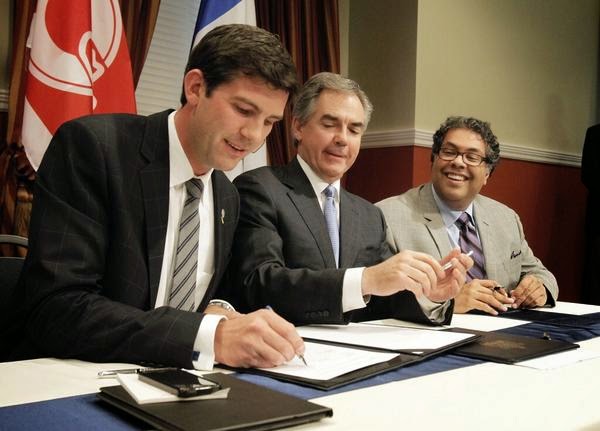
Premier, Edmonton Mayor, and Mayor Nenshi sign Framework Agreement for Charters

Edmonton Mayor Don Iveson, Premier Jim Prentice and Mayor Nenshi.
Photo by Lyle Aspinal, Calgary Sun (via Twitter)
This afternoon, I was pleased to join with Premier Jim Prentice and Edmonton Mayor Don Iveson to sign a "Framework Agreement For Charters" between our orders of government. City charters for Alberta's big cities is something we've been working on for some time, and this framework is an important step toward achieving this important legislative change. A charter makes it easier for our cities to serve our citizens with the services they need the most and it will definitely improve the lives of Calgarians and Edmontonians. I look forward to working with the Premier and Minister Diana McQueen to redefine the relationship between the province and our two biggest cities.

Story: ,

Statement from Mayor Nenshi regarding flood recovery announcement from Premier Prentice

We are pleased that the Premier has made flood recovery and mitigation a major priority, but we are surprised at the scope of the announcement, as it represents a significant departure from previous policy, and it was announced without prior discussion with the City's flood experts or policy-makers. The Premier, just yesterday, announced he would be treating municipalities as true partners. We look forward to that.
We are pleased that the Premier announced that the government is tripling the number of appeal officers for the Disaster Recovery Program. This will make a real difference for the families affected by the flood. We hope that when processing these appeals, the Provincial government will address the legitimate concerns that have been raised by flood affected families and that their claims will be re-assessed properly, fairly and quickly.
With respect to the two flood mitigation measures for Calgary that were announced by Premier Prentice today - namely the dry reservoir in Springbank and the direction to negotiate a permanent water management agreement with TransAlta - it is difficult for us to comment in detail since The City of Calgary has not yet been consulted with respect to either proposal and our experts have not yet seen any engineering studies. 
However, we do have a few initial observations:
1.    The "room for the river" concept for the Springbank reservoir, while intriguing, has never been discussed with City officials. It represents a real departure from the previous plan, where the reservoir would have played a role in both flood and drought years. This dry dam would not be used except during a flood and would not allow for comprehensive water management, which the Province had previously stated was their goal for this project. 
2.    We are very interested to hear the Premier state that management of the existing TransAlta dams will offer 1:100 year flood protection and that the Springbank dry dam will offer 1:200 year flood protection. We will be asking Provincial officials to share their engineering studies that demonstrate that. Based on our research and analysis to date, we believe that at least two and maybe all three proposed large scale flood mitigation measures will be required (namely, Springbank, McLean Creek and the Glenmore Reservoir Tunnel).  It is surprising that the Province would announce one project without having completed the analysis on the impact of the other two projects, since they all must be analyzed together. For example, using hypothetical numbers, it may be that the tunnel could be double the cost of the other projects but it may mean that either or both other projects would no longer be needed. The cost-benefit analyses cannot stand alone. 
3.    The Government of Canada in a recent study indicated that 1:100 year standard is no longer appropriate. Calgary needs protection to a much higher level. Recent discussions with Provincial officials have been focused on mitigation at a significantly higher standard.
The floods had a devastating impact on our community and it is very important that we make the right decisions with respect to flood mitigation projects. Teams from the City and the Province have been working very collaboratively under the previous two Premiers and we hope that continues under the "new management". 

- Mayor Naheed Nenshi
Story:

Column: Cities matter, but does the next Premier know?

Like many Albertans, I was excited about the Progressive Conservative leadership race. The battle to be our next premier had attracted three good candidates with very different philosophies. And it would unfold over many months, giving Albertans plenty of time to see the candidates interact, and for the candidates to share their visions for the province and the policies to make those visions real.

As we know, the experience has been quite different. There have been few debates, and the policy announcements have ranged from the irrelevant to the bizarre. I’ve heard few specifics about the issues that Albertans consistently rank as most important to them whether it be education funding, significant improvement to the health care system, or (of course) Alberta’s big cities.

Nonetheless, I have a lot of respect for all three candidates. I had the chance to sit down with all three earlier this summer and had great meetings with each. They listened and engaged intently as I highlighted the issues of concern to The City of Calgary.

All do agree that the relationship between The City and The Province was broken, and that the funding model—under which Calgary taxpayers send $4 billion more to The Province than we receive in all provincial services every year—needed to be addressed.

We have to have these conversations because they matter so much to the lives of Calgarians. For example, the creation of the Green Line (the north-central and south-east LRT) is a priority for our citizens, but if we can’t figure out how to cover the $5 billion price tag together, it will not get built. We need that and so much other infrastructure because the growth of our cities—and the needs associated with that growth—is very real. In the last three years, Calgary gained more people than the entire population of Red Deer. We need to act now to find solutions to that and other topics ranging from providing front-line services to eliminating homelessness and poverty in our cities.

With this in mind, I asked the candidates to respond to a survey called Cities Matter. We’ve done this before. In the last PC leadership race and in the last provincial election, we asked each candidate or party specific questions on how they would address city issues, and they all did so. We published their results verbatim to help voters make up their minds.

This time around, all the campaigns responded to the survey without any prodding, and we’ve once again posted the results at CitiesMatter.ca.

I will admit that I am a bit disappointed. No candidate staked out any bold positions. The answers ranged from vague (at best) to taking us backward (at worst).

We’ve been working diligently on a city charter, for example, through three premiers and four municipal affairs ministers. The PC Party in the last election highlighted the need for these charters. However, all three candidates would take us a step backward on this, something that Calgarians and Edmontonians can ill afford.

None of the candidates offered a clear way forward on the stalled Calgary Metropolitan Plan, and none talked in any detail about how they would assist cities with the cost of growth, infrastructure, downloaded social servicing or policing. None could even muster up the ability to say that abruptly cutting all funding to Calgary’s Performing Arts Centre (a tiny amount for this government but huge for the arts community) was a mistake.

What I am looking for is specific policy ideas that we could debate and discuss with citizens. Even if the policy positions were “the Mayor is wrong and here’s why”, we’d have a place to begin.

There was some good news: all three candidates will review (and hopefully reverse) Alberta Health Services’ decision to make unnecessary, costly changes to a 911 system that is working very well as it is. All of them were willing to work with the cities as partners, not as enemies. If we’re going to ensure the prosperity of this province and its citizens, we must work together to build the cities we need—cities that move, that are affordable, and where people want to live and thrive.

All five parties in the last election agreed that the current system doesn’t work and that change is needed. The Opposition parties have, in varying degrees, developed plans, policies, and commitments to fix the problems. Some are good, some are bad, but they exist.

Our new Premier will have a short period of time to catch up and prove to all Albertans that cities matter. And I sincerely look forward to working with him to help make that happen.

- Mayor Naheed Nenshi
Story: ,

Cities Matter: The 2014 PC Leadership edition


Fellow Calgarians and Albertans,

Today, we are relaunching CitiesMatter.ca--the home for responses from Alberta's Progressive Conservative (PC) Leadership Candidates about the issues facing our cities today. Please visit it and share it with your colleagues, friends, and family.

Strong, healthy cities require thoughtful vision and action from all orders of government. But if we don’t ask our politicians for that, we may never get it. There is often a sad lack of discussion (from the provincial and federal governments) about the issues that affect us every day. Supporting front-line services, eliminating homelessness and poverty, fixing the fiscal imbalance, and creating a sustainable transportation strategy with cities (just to name a few topics) all too often fall off the political radar.

CitiesMatter.ca is one way we--the citizens of cities--can raise our voices to ensure better discussions with our politicians about how we can make our cities better. During the last provincial election (April 2012) and the last PC leadership race (October 2011) The City of Calgary surveyed provincial political parties and leadership candidates about the issues that matter most to cities.

Thank you to all the candidates for responding to the survey, and congratulations to all the candidates and volunteers who participated in this race. It takes a lot to put yourself out there and represent your fellow citizens.

And thank you all for visiting and exploring CitiesMatter.ca. Your participation in these issues makes a difference, and it shows that cities do (truly) matter.

[UPDATE: I've now posted my analysis of the responses from the three candidates.]

Sincerely,

Mayor Naheed Nenshi
Story: ,

Mayor Nenshi's statement on Premier Redford's resignation (video)

Following the resignation of Premier Alison Redford, Mayor Naheed Nenshi met with reporters to share his perspective. Here is the video of that statement: